

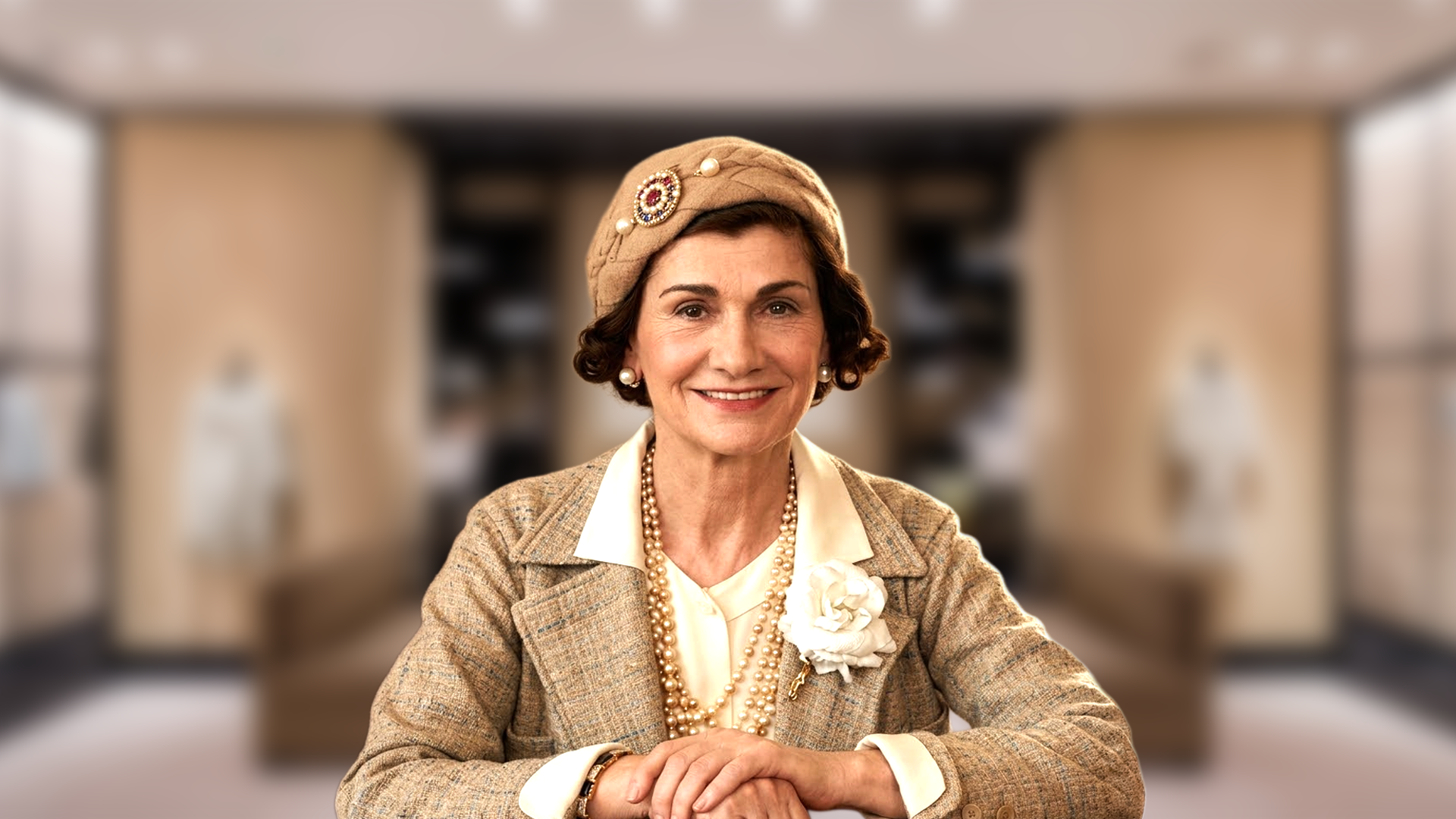
Before the name Coco Chanel became synonymous with quiet elegance and Parisian couture, Gabrielle Chanel was a young girl growing up far removed from the salons that would later celebrate her genius. Born into modest circumstances, Chanel did not simply rise within the world of fashion; she reshaped its very grammar. Through a rare combination of aesthetic clarity and entrepreneurial instinct, she built Chanel into one of the most enduring luxury houses in history, transforming women’s fashion and redefining modern elegance.
More than a designer, Chanel was a cultural architect. At a time when women were confined by elaborate corsetry and ornamental excess, she envisioned clothing that moved with the body. In doing so, she introduced a philosophy of luxury rooted not in spectacle but in restraint, an idea that continues to define the House of Chanel more than a century later.
From Convent Shadows to the Seeds of Vision
Gabrielle Bonheur Chanel was born on 19 August 1883 in Saumur, France. Her mother worked as a laundress while her father travelled as a street vendor, and stability was rare in her early years. When Gabrielle was twelve, her mother died, and she was placed in the convent orphanage of Aubazine.
Within its disciplined walls she learned sewing, a skill that later became the foundation of her empire. The austere environment also cultivated her appreciation for minimalism and monochromatic palettes, elements that would later define Chanel’s aesthetic.
After leaving the orphanage, Gabrielle worked as a seamstress and occasionally performed in cafés. During these evenings audiences began calling her “Coco,” a nickname that would soon eclipse her birth name.
Though her circumstances were humble, Chanel possessed a strong instinct for independence and style that would soon carry her beyond the margins of Parisian society.
The Birth of a House: Chanel Modes and a New Aesthetic
The year 1910 marked the beginning of Chanel’s entrepreneurial journey when she opened her first millinery boutique, Chanel Modes, at 21 Rue Cambon in Paris. Unlike the elaborate hats fashionable during the Belle Époque, Chanel’s designs were restrained and elegant.
Parisian actresses quickly embraced her creations, and Chanel’s reputation began spreading through the city’s artistic circles. Encouraged by this success, she expanded with boutiques in Deauville and Biarritz, where she introduced clothing suited to a modern lifestyle.
It was here that Chanel introduced one of her earliest revolutions: the use of jersey fabric in womenswear. Previously associated with men’s undergarments, the jersey was soft, practical, and comfortable. By transforming this material into fashionable garments, Chanel helped free women from the rigid silhouettes that had dominated fashion for decades.
What emerged during these years was not merely a new style but a new philosophy of dressing, one built on ease, confidence, and movement.
The Creation of Chanel No. 5
Every iconic founder story contains a moment when vision transforms into legacy. For Chanel, that moment arrived in 1921 with the creation of Chanel No. 5.
Working with perfumer Ernest Beaux, Chanel sought to create a fragrance unlike the delicate floral perfumes popular at the time. Her ambition was unconventional: she wanted a scent that reflected the complexity of a woman rather than a single flower.
Beaux presented several numbered samples. Chanel chose the fifth bottle, her lucky number, and the fragrance became Chanel No. 5. Equally revolutionary was the bottle itself. Instead of ornate perfume packaging common at the time, Chanel selected a minimalist glass design with clean lines.
The result was transformative. Chanel No. 5 became one of the most recognizable fragrances in the world and established a powerful new idea: a fashion house could extend its identity beyond clothing into a complete lifestyle universe. With Chanel No. 5, Gabrielle Chanel expanded fashion into culture.
The Little Black Dress and the Democratization of Chic
In 1926, Chanel introduced another defining innovation: the Little Black Dress. Black clothing had long been associated with mourning, yet Chanel reimagined the color as the epitome of modern sophistication. When the design appeared in Vogue, its simplicity stunned the fashion world.
The magazine famously compared the dress to the Ford Model T, predicting it would become a universal wardrobe essential. Nearly a century later, that prediction remains true.
With this garment, Chanel demonstrated that style does not require extravagance, sometimes the most powerful statement lies in simplicity.
The Codes of Chanel: Crafting a Luxury Empire
Throughout the 1920s and 1930s, Chanel refined the design vocabulary that would define her brand for generations. Among her most influential creations were the Chanel suit, quilted handbags, and costume jewellery, designs that combined practicality with unmistakable elegance.
By the late 1920s, Chanel owned multiple buildings along Rue Cambon in Paris, transforming the address into the center of a growing luxury empire. Her designs resonated with a generation of women seeking independence and modernity, making Chanel not only a designer but a symbol of cultural change.
War, Silence, and the Return of a Legend
The outbreak of the Second World War dramatically altered Chanel’s career. In 1939 she closed her couture house and withdrew from the fashion world for several years.
Many believed her influence had faded. Yet in 1954, at the age of seventy-one, Chanel returned with a new collection that rejected the exaggerated silhouettes dominating postwar couture. Instead, she revived her philosophy of understated elegance, structured jackets, relaxed skirts, and clothing designed for modern movement.
Though critics initially resisted the collection, American women embraced its practicality, restoring Chanel’s influence in global fashion.
Legacy: The Enduring Language of Chanel
Gabrielle “Coco” Chanel died in Paris on 10 January 1971, leaving behind not merely a fashion house but a philosophy. Today the House of Chanel remains one of the world’s most influential luxury brands, built upon the principles Chanel established decades earlier: simplicity, independence, and confidence.
Her greatest contribution was not simply the garments she designed but the freedom she introduced into fashion. By replacing restriction with movement and ornamentation with clarity, Chanel transformed the language of luxury, one that continues to define modern style today.
