

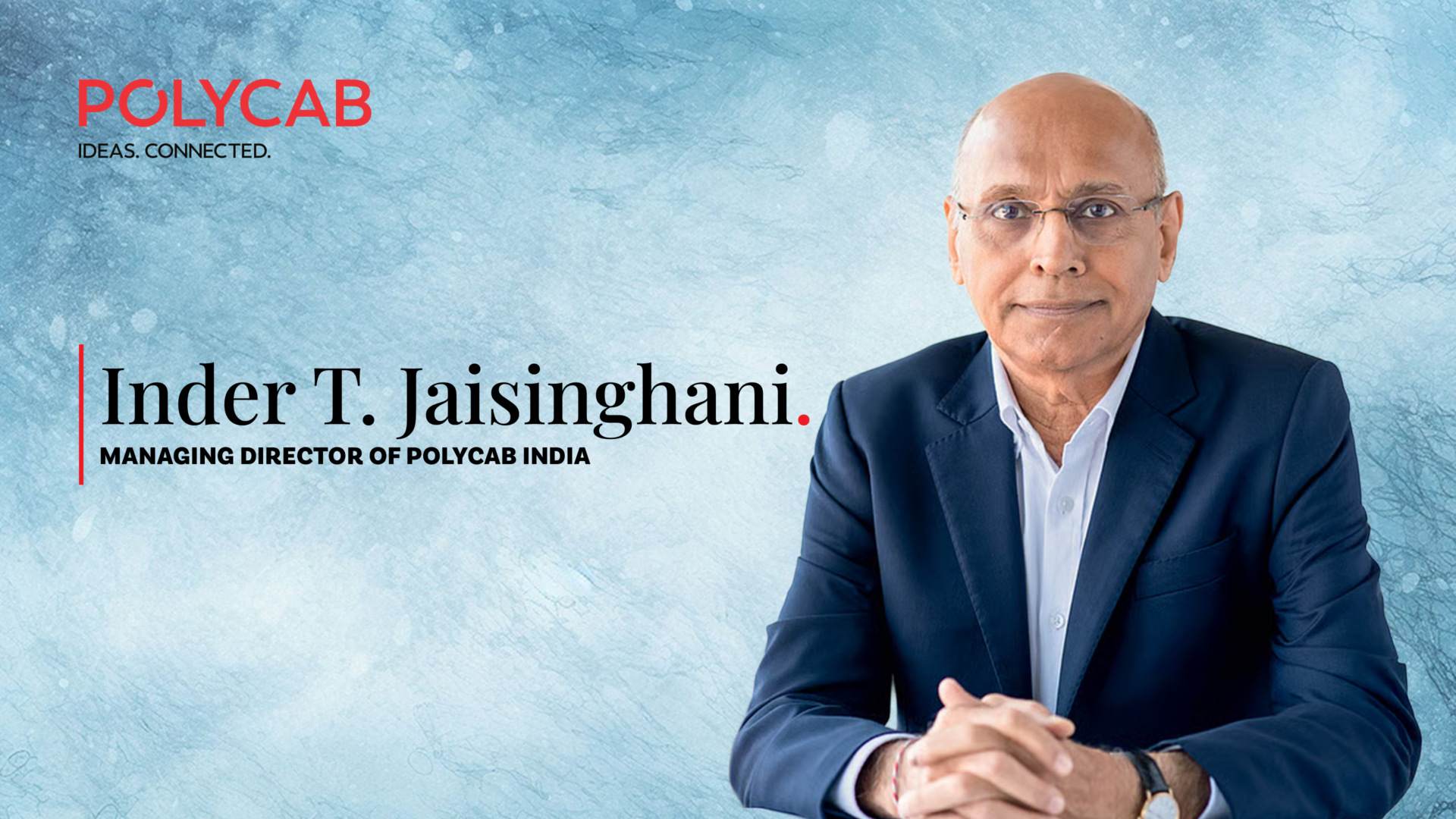
In the crowded trading lanes of Mumbai’s Lohar Chawl, where narrow storefronts once overflowed with coils of copper wire, switches, and electrical fittings destined for the city’s expanding skyline, a teenage boy quietly stepped into a responsibility that would eventually illuminate millions of homes across India. That young boy was Inder T. Jaisinghani, who today stands as the architect behind Polycab India, a company that has grown into India’s largest manufacturer of wires and cables and a major force within the nation’s electrical infrastructure ecosystem.
The scale of Polycab today, an enterprise valued at more than ₹1 lakh crore, may suggest a meticulously planned corporate ascent, yet the company’s origins lie in circumstances shaped less by ambition and more by necessity. Born into a modest Sindhi family, Inder spent his early years observing the workings of his father’s electrical trading shop, Sind Electric Stores, which supplied fans, switches, and electrical components to electricians and contractors across Mumbai. Though small in size, the shop operated on principles that would later define Polycab’s identity: integrity in business dealings, product reliability, and an unwavering commitment to customer trust.
That stability was abruptly disrupted in 1968 when his father passed away unexpectedly, leaving behind a grieving family and a fragile enterprise that represented their sole means of livelihood. At just fifteen years of age, Inder made a decision that would shape his life: instead of continuing his education, he stepped behind the shop counter and assumed responsibility for sustaining the family business.
What began as an act of duty slowly evolved into the beginning of an extraordinary entrepreneurial journey.
Learning the Electrical Wires and Cables Industry from the Ground Up
Operating a small electrical trading shop in Lohar Chawl proved to be a demanding yet invaluable education in the realities of commerce. Each day involved negotiating with suppliers, managing inventories, and interacting with electricians whose professional reputations depended on reliable materials.
Through these experiences, Inder recognised a structural limitation within the trading model. Retailers remained dependent on manufacturers who controlled pricing, supply timelines, and product availability, leaving traders with little influence over margins or long-term stability.
For a young entrepreneur already aware of how fragile economic security could be, such dependence appeared unsustainable. Gradually, the idea emerged that true independence could only be achieved by moving beyond trading and entering the world of manufacturing.
That realisation quietly planted the seed from which Polycab would eventually emerge.
The Garage That Became the Birthplace of a Manufacturing Vision
During the mid-1970s, Inder and his brothers took the bold step of establishing a small manufacturing operation dedicated to producing electrical wires. With limited capital and modest infrastructure, the first production unit functioned from a garage where persistence and resourcefulness compensated for the absence of sophisticated industrial equipment.
From the very beginning, Inder insisted that quality must remain the cornerstone of the enterprise. The electrical market at the time contained many products that sacrificed durability in favour of lower prices, often creating safety risks for homes and buildings. Determined to differentiate his company, he chose a path that prioritised reliability over short-term profitability.
Electricians soon began recognising the difference. Contractors discovered that the wires produced by the young enterprise delivered consistent performance and reduced the likelihood of costly electrical failures. Gradually, within professional networks where trust carried immense value, the brand began earning a reputation for dependability.
“In our industry, quality is not a marketing strategy; it is a responsibility,” Inder would later remark, a philosophy that continues to define the company’s approach to manufacturing.
The Difficult Years That Forged Industrial Discipline
The transformation from a modest garage operation into a recognised manufacturer was neither immediate nor easy. Producing electrical cables required significant investment in machinery, raw materials such as copper, and skilled technicians capable of maintaining strict insulation and safety standards.
For a family-run enterprise with limited financial resources, each expansion decision involved considerable risk. Machinery breakdowns, volatile copper prices, and supply disruptions frequently created moments of uncertainty that demanded patience and discipline.
Rather than pursuing rapid expansion driven by market excitement, Inder adopted a philosophy of measured growth in which profits were reinvested into improved manufacturing processes, stronger quality controls, and gradually expanding distribution networks. This disciplined approach created the foundation that later supported the company’s remarkable growth.
The Strategic Turning Point That Transformed Polycab into a National Brand
The defining turning point in Polycab’s evolution arrived during the late 1980s and early 1990s, when India’s economic reforms accelerated infrastructure development across the country. Rapid urbanisation, industrial expansion, and large-scale construction projects created rising demand for reliable electrical cables.
Recognising the scale of this opportunity, Inder concluded that the company could no longer remain a modest regional manufacturer. If Polycab wished to participate meaningfully in India’s infrastructure growth, it would need to evolve into a national brand supported by modern manufacturing capabilities and a robust distribution network.
This decision became the decisive “red dot moment” in the company’s journey. By investing in manufacturing technology and expanding distribution channels across India, the company positioned itself for sustained growth. In 1996 the enterprise was formally incorporated as Polycab Wires Pvt. Ltd., marking its transformation into a professionally structured organisation capable of competing nationally.
Over the following decades, Polycab expanded beyond building wires into power cables, control cables, communication cables, and a broad range of fast-moving electrical goods including fans, switches, and lighting systems. Today, India’s wires and cables industry is estimated to be worth more than ₹80,000 crore, and Polycab occupies a commanding position within this dynamic sector.
From Family Enterprise to a ₹1 Lakh Crore Market Leader
After decades of steady expansion, Polycab achieved a defining milestone in 2019 when the company launched its Initial Public Offering. The market’s response was extraordinary, with the offering oversubscribed more than fifty times, reflecting strong investor confidence in the company’s operational discipline and long-term growth prospects.
By 2024 the company’s market capitalisation had crossed ₹1 lakh crore, firmly establishing Polycab as one of India’s most influential electrical manufacturing enterprises.
Despite this success, Inder Jaisinghani remains a notably private leader who prefers operational focus over public attention. Colleagues often describe him as a leader who stays closely connected to the factory floor, interacting with engineers and technicians to ensure that the company’s quality standards remain uncompromised.
Powering India’s Electrified and Sustainable Future
As India advances toward a future shaped by renewable energy, electrified mobility, and intelligent infrastructure, Polycab has begun positioning itself as a comprehensive energy solutions provider. The company has expanded into fast-moving electrical goods, solar technologies, and energy-efficient solutions aligned with the nation’s evolving energy landscape.
Through these initiatives, Polycab continues strengthening its role within the essential infrastructure that powers homes, industries, hospitals, and cities across India.
A Legacy Built on Quiet Determination
The story of Inder T. Jaisinghani ultimately illustrates that enduring industrial legacies rarely emerge through dramatic gestures or sudden breakthroughs. Instead, they are built through decades of disciplined effort, thoughtful decisions, and an unwavering commitment to trust.
From a teenage boy determined to protect his father’s modest shop to the architect of a ₹1 lakh crore enterprise, his journey demonstrates how resilience, patience, and integrity can transform humble beginnings into institutions that illuminate the future of an entire nation.
And in every cable carrying electricity across India today lies a quiet reminder of that philosophy: that the most powerful currents of progress are often driven not by spectacle, but by trust.