

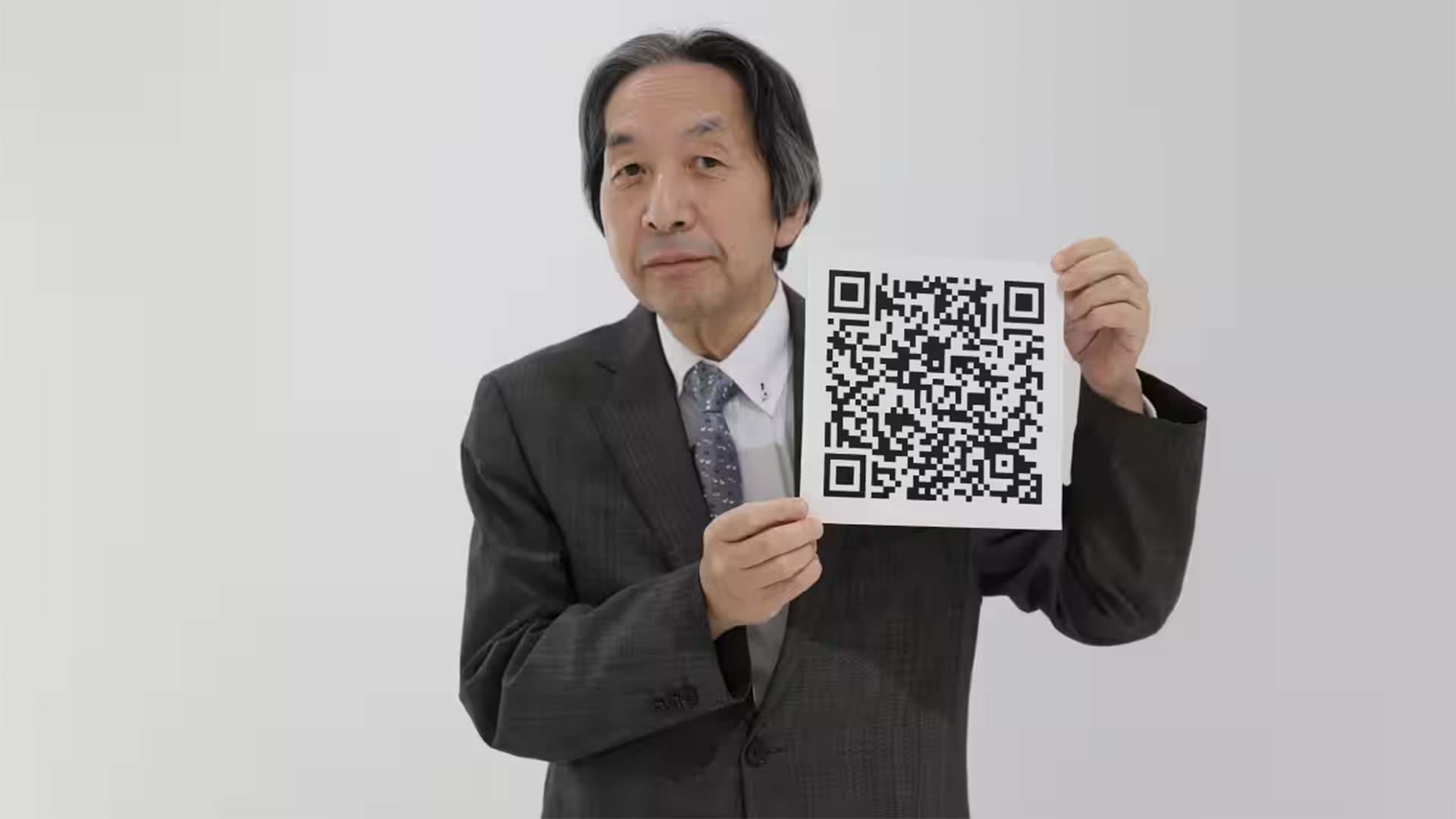
The QR code is one of those inventions that feels as if it has always existed. It appears when we pay for tea at a roadside stall, when we board a flight, when we open a restaurant menu, or when we verify a digital document. A brief scan links the physical world to the digital one, and then the technology fades from view. It works so smoothly that most people never pause to think about it.
Yet behind this ordinary moment lies a rare design philosophy. The QR code did not become universal because it was aggressively sold or tightly controlled. It became universal because it was allowed to belong to everyone. The story of how that happened begins with a quiet Japanese engineer who believed that systems become stronger when they are trusted.
This Founder Story documents the journey of Masahiro Hara, the engineer who created the QR code, and how his belief in openness over ownership reshaped global commerce, payments, and digital connectivity. Long before QR codes became a part of everyday life, his philosophy centred on universality over control and trust over restriction. This story explores how that approach took form and why it remains deeply relevant in a world increasingly governed by digital infrastructure.
Early Journey
Masahiro Hara did not set out to become a global inventor. He joined DENSO WAVE, a subsidiary of the Toyota Group, in the late 1980s, in a corporate environment shaped by discipline, precision, and quiet improvement. Engineers were valued for solving problems patiently rather than seeking recognition, and Hara fit naturally into this culture. He was observant, thoughtful, and deeply curious about how systems behaved under pressure.
Outside work, Hara devoted time to the ancient board game Go. The game rewards players who understand space, balance, and long-term positioning rather than immediate victories. He often reflected that Go taught him to see relationships across a surface, not just individual moves. That habit of thinking soon began to shape how he approached a problem that had quietly troubled factory floors for years.
The Problem
By the early 1990s, Japanese manufacturing had reached extraordinary efficiency, yet product tracking was still constrained by the limits of one-dimensional barcodes. These codes could hold only small amounts of information. As components became more complex, multiple barcodes had to be printed on a single part, forcing workers to scan repeatedly. Errors accumulated, time was lost, and a system designed for speed began to strain under its own complexity.
Most engineers tried to improve the barcode itself. Hara questioned the assumption behind it. Information, he realised, does not exist in a straight line. It exists in space. If data could be read both horizontally and vertically, a code could carry far more meaning without becoming harder to use.
For months, Hara and his team tested this idea relentlessly, studying newspapers, packaging, and printed material to find visual patterns that scanners could detect without confusion. Eventually, they identified a specific ratio of black and white that almost never occurred naturally. From this emerged the QR code’s distinctive square finder patterns, allowing scanners to recognise and orient the code instantly.
In 1994, the Quick Response code was officially introduced. It could store thousands of characters and be read far faster than any barcode before it. DENSO WAVE secured patents for the invention, and at that moment a decision had to be made. The company could license the technology, control its use, and monetise every scan, or it could allow the system to spread freely. For Hara, this was not an abstract business choice. If QR codes were locked behind ownership, they would fragment and stall. If they were released, the company would surrender control and certainty. Supporting openness meant walking away from guaranteed revenue and placing faith in adoption instead. Yet Hara understood that a system designed to connect the world could not thrive if it belonged to only one institution.
Philosophy & Leadership
“When someone is trusted to use a system freely, they become invested in making it work,” Hara once observed. “That trust is what allows something to grow beyond its creator.”
DENSO WAVE ultimately chose not to enforce its QR code patents for standard use. The decision unsettled many within the organisation. Some feared competitors would copy the idea, others worried about lost profits. But restraint became the QR code’s greatest strength. Without licensing barriers or proprietary restrictions, the system spread across industries and borders, becoming a shared language between machines, businesses, and people.
Impact
For several years, QR codes remained primarily an industrial tool. Then smartphones transformed their role. As mobile cameras and internet access became widespread, QR codes became the simplest bridge between the physical and digital worlds. In places like China, they evolved into the backbone of everyday payments, enabling a cashless economy that stretched from street vendors to major corporations. The technology itself had not changed; its openness had allowed others to imagine what it could become.
Today, QR codes sit at the centre of global logistics, healthcare, airline boarding passes, restaurant menus, digital identity, and financial transactions. They are scanned billions of times every day, so seamlessly integrated into life that most people no longer think of them as technology at all.
Legacy
Masahiro Hara never sought to build a personal empire around his invention. He chose to step back and allow the system to belong to the world. In doing so, he demonstrated a form of leadership rooted not in control, but in restraint, trusting that what is shared widely can endure more deeply.
In documenting his journey, The Founders Stories preserves not just the origin of a widely used tool, but the philosophy that allowed a simple black-and-white square to become part of humanity’s shared digital infrastructure. It is a reminder that the most enduring innovations are often the ones that disappear quietly into everyday life, shaping how the world moves without demanding to be noticed.