
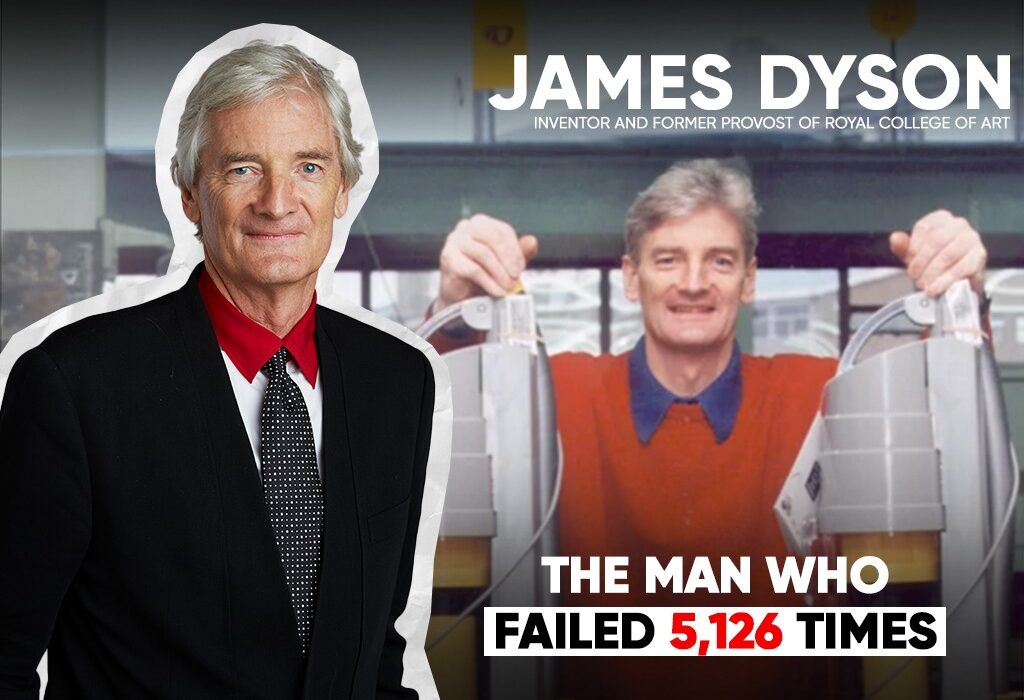
The Man Who Failed 5,126 Times Before the World Listened
There’s a certain kind of silence that surrounds failure. It’s the sound of self-doubt, of nights spent questioning whether persistence still has purpose. For most, it’s the point of surrender. For James Dyson, it was where everything began.
The British inventor spent five long years creating 5,126 failed prototypes in a small shed, before one worked. Today, his name is synonymous with innovation, his company’s products redefine design, and his personal story has become a global parable of perseverance. Yet, his path to triumph was anything but straightforward. It was built on obsession, resilience, and an unshakable faith that even failure, repeated enough times, eventually bends toward success.
It started, quite unceremoniously, with a vacuum cleaner. One afternoon in the late 1970s, Dyson was cleaning his home when he noticed that his machine kept losing suction. On investigation, he discovered that the dust bag was clogging, a flaw everyone had accepted as normal. But Dyson couldn’t.
“I get frustrated when things don’t work properly,” he later said. “I find it motivating.”
That frustration became the spark of an idea. He remembered a sawmill he had once visited that used a cyclone system to separate dust from air. “If it works for sawdust,” he thought, “why not for household dust?”
It was a simple question. But the answer would take him through years of solitude, debt, and relentless trial and error.
Five Years. Five Thousand Failures. One Relentless Vision.
Dyson began experimenting in his garden shed in the English countryside. He had no funding, no team, just sketches, scrap materials, and an idea that wouldn’t let him go.
For five years, he worked alone, creating prototype after prototype. Each time, the machine would clog, break, or simply not work. But with every failure came refinement. “I made 5,126 prototypes,” he once revealed. “Each one taught me something new.”
By the time he built his 5,127th model, the bagless vacuum cleaner was born, the first of its kind, powered by cyclonic separation. It maintained full suction without needing a disposable bag. Dyson was ecstatic. The world, however, was not.
Every major manufacturer he approached turned him away. They told him there was no market for his product. The reason, as Dyson later learned, was painfully ironic, his invention threatened the lucrative dust bag industry.
“They didn’t want a vacuum cleaner that didn’t need bags,” he said. “It wasn’t in their interest.”
Rejection became his constant companion. But Dyson refused to stop. He mortgaged his home, sold personal belongings, and continued perfecting his design. “You never learn from success,” he once reflected. “You only learn from failure.”
In 1983, salvation came from an unexpected place, Japan. A company there licensed Dyson’s design and launched the G-Force vacuum cleaner. It was sleek, futuristic, and expensive, marketed not as an appliance, but as a status symbol.
The Japanese market embraced it. The royalties Dyson earned finally gave him enough capital to start his own company, Dyson Ltd., in 1993.
That same year, he launched the DC01, the first Dyson vacuum cleaner under his own brand. Its transparent dust container was both functional and symbolic, an open declaration of performance. “People like to see what they’ve cleaned up,” Dyson said with a smile.
Within two years, it became the best-selling vacuum cleaner in Britain. The man who had been rejected by everyone now owned the future of household innovation.
Dyson’s success didn’t lie merely in invention, it lay in reinvention. His philosophy was simple: design should solve problems. “Good design,” he said, “starts by asking the right questions. Why does this exist? What’s wrong with it? And how can it be better?”
His company would go on to revolutionize industries beyond cleaning. From bladeless fans and Supersonic hair dryers to hand dryers and air purifiers, Dyson’s designs turned ordinary appliances into feats of engineering. His products didn’t just work, they redefined the relationship between form and function.
“I’m an engineer,” he once said. “I like solving problems. That’s what keeps me awake at night, and gets me up in the morning.”
Even as a billionaire, Dyson never lost his willingness to risk failure. In 2017, he embarked on a bold new venture, building an electric car. For two years, his engineers developed cutting-edge batteries, designs, and motors. The prototype was brilliant, but not viable. In 2019, Dyson cancelled the project, having spent £2 billion of his own money.
“It was a tough decision,” he admitted. “But it wasn’t a failure. We learned so much that will inform future technologies.”
His words echo a truth few innovators embrace: failure isn’t the opposite of success, it’s the foundation of it.
Dyson’s journey has also been about nurturing future inventors. In 2002, he established the James Dyson Foundation to inspire young engineers. Its global James Dyson Award challenges students to “design something that solves a problem,” a simple prompt that has led to groundbreaking inventions across the world.
He also founded the Dyson Institute of Engineering and Technology, where students can earn degrees while working directly alongside engineers at Dyson. “We need more problem solvers,” he said. “People who aren’t afraid to fail.”
Through these initiatives, Dyson’s greatest creation may not be a machine, but a mindset.
Despite his fame and fortune, Dyson remains disarmingly humble. He lives quietly with his wife, Deirdre, an art teacher, and continues to test prototypes himself. His workshops are filled with sketches, mock-ups, and ideas in motion.
He’s still chasing problems that frustrate him, not for profit, but for the thrill of creation. “I love mistakes,” he once confessed. “They make you think differently.”
Today, Dyson Ltd. employs over 14,000 people, operates in more than 80 countries, and invests millions weekly in research. His net worth exceeds $20 billion. Yet when asked what drives him, he answers simply: “Curiosity.”
Sir James Dyson’s story is more than a tale of engineering success. It’s a human story, one of persistence, courage, and quiet rebellion against mediocrity.
In a world obsessed with speed and instant success, Dyson reminds us that greatness often hides in the unglamorous act of trying again and again and again.
“Enjoy failure and learn from it. You can never learn from success.”
That’s not just an inventor’s advice, it’s a philosophy for life. Because Dyson’s greatest invention was never just a vacuum cleaner.
It was the art of never giving up.