

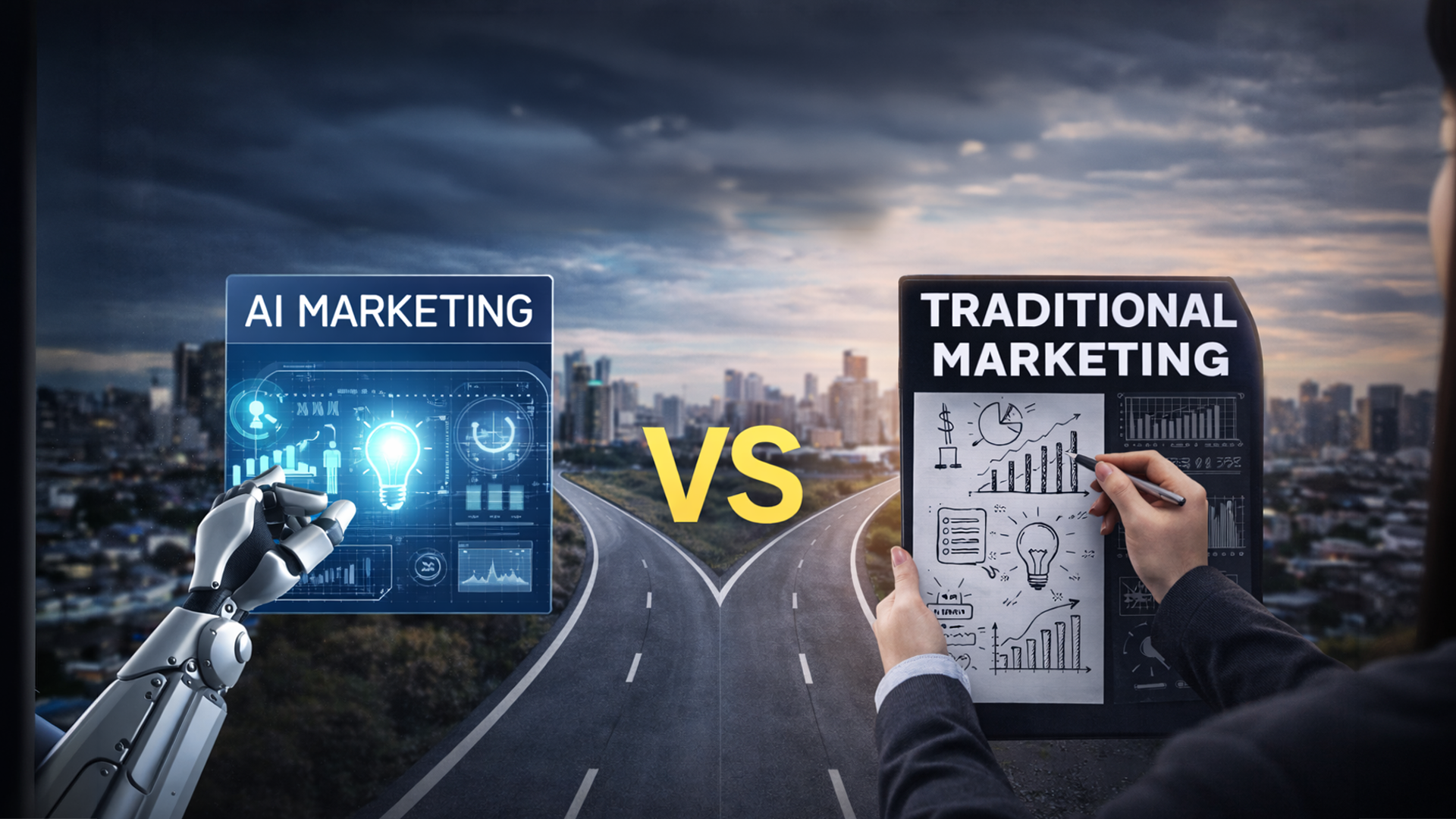
Marketing strategy has always reflected the dominant technologies of its time. Print, broadcast, digital and social media each reshaped how organisations communicated, measured success and understood audiences. Artificial intelligence now presents a comparable inflection point. Yet much of the debate remains imprecise, oscillating between exaggerated promise and misplaced anxiety. A clearer assessment emerges when AI-driven marketing strategy is examined not as a replacement for traditional practice, but in direct comparison with it.
This article sets out that comparison. By examining how traditional marketing strategy and AI-enabled marketing strategy differ in judgement, execution, scalability and brand control, it becomes possible to understand what is genuinely changing and what remains firmly human.
Human Judgement Vs Systemic Judgement
Traditional marketing strategy has been grounded in human judgement. Decisions around messaging, channel selection and timing have historically relied on professional experience, cultural insight and retrospective data analysis. While data has long informed strategy, interpretation and prioritisation remained human-led.
AI-driven marketing introduces a different logic. Here, judgement is increasingly distributed across systems. Machine learning models and agent-based architectures evaluate patterns continuously, weighing probabilities rather than opinions. Strategic intent is still defined by humans, but executional judgement deciding what happens next is often delegated to algorithms operating at speed and scale.
This does not eliminate human decision-making; rather, it relocates it. Humans design objectives, constraints and ethical boundaries, while AI systems optimise within those parameters. Analysts at McKinsey & Company have described this as a shift from episodic decision-making to continuous optimisation, particularly in customer experience and lifecycle management.
Periodic Campaigns vs Continuous Adaptation
In traditional marketing, strategy unfolds through defined cycles. Campaigns are planned, launched, measured and refined. Even in digital environments, optimisation often occurs after performance reviews rather than during live execution. This structure provides clarity and creative control but limits responsiveness.
AI-driven strategies operate differently. Systems ingest real-time data and adjust actions continuously. Content sequencing, channel allocation and audience prioritisation can change dynamically based on behaviour signals. Agentic systems are capable of coordinating multiple actions over time, pursuing long-term objectives rather than isolated wins.
This continuous mode challenges long-standing planning assumptions. Annual calendars and fixed media plans give way to adaptive frameworks. The strategic task becomes less about predicting outcomes and more about designing systems that learn responsibly.
Segments vs Individuals
Traditional marketing strategy relies on segmentation. Audiences are grouped by demographics, psychographics or behaviour, and messages are crafted for each segment. This approach balances relevance with operational feasibility, but inevitably simplifies individual complexity.
AI-enabled marketing, by contrast, is capable of operating at the level of the individual. Advanced models assess context, history and intent in real time, enabling what consultants often describe as “next-best-action” or “next-best-experience” frameworks. These systems do not merely personalise content; they personalise decisions.
The distinction is strategic, not cosmetic. Segment-based marketing optimises averages. AI-driven marketing optimises probabilities at scale. When governed well, this can increase efficiency and relevance simultaneously. When governed poorly, it risks incoherence or overreach, a point frequently emphasised by analysts at Gartner in their assessments of enterprise AI adoption.
Retrospective Analysis vs Embedded Feedback
Measurement in traditional marketing is largely retrospective. Performance is evaluated after execution, with insights feeding into future planning cycles. Attribution models attempt to assign credit, but causality often remains contested.
AI-driven marketing embeds measurement into execution itself. Feedback loops operate continuously, allowing systems to learn from outcomes as they occur. This creates opportunities for rapid improvement but complicates accountability. When decisions are distributed across systems, responsibility must be clearly defined.
Strategically mature organisations address this by insisting on transparency: decision logs, explainable models and human override mechanisms. Without these safeguards, optimisation can obscure rather than illuminate performance.
Singular Authorship vs System Consistency
A common concern is that AI-driven marketing diminishes creativity. In practice, the distinction lies not in creativity itself but in authorship. Traditional marketing celebrates singular creative acts, campaigns, slogans, narratives, often associated with identifiable teams or individuals.
AI-enabled strategy prioritises consistency over singular moments. Brand voice becomes a system property rather than a campaign feature. Creativity is modularised: prompts, rules and examples guide output, ensuring coherence across channels and time.
This requires a different kind of creative discipline. Instead of producing finished artefacts, teams design creative frameworks that machines can interpret and extend. The creative act shifts from execution to orchestration.
Managerial Oversight vs System Stewardship
Risk management in traditional marketing is largely managerial. Decisions are reviewed, approvals are granted, and reputational risks are mitigated through human judgement. Errors are visible and attributable.
AI-driven marketing introduces new forms of risk: unintended optimisation, bias amplification and loss of contextual sensitivity. These risks cannot be managed solely through approval hierarchies. They require system-level governance.
This includes ethical guidelines, data quality standards and clear escalation protocols. Gartner has repeatedly cautioned that organisations underestimating governance requirements are likely to abandon ambitious AI initiatives due to trust deficits rather than technical failure.
Implications for Professional and Personal Branding
The consequences of this strategic shift are not confined to organisations alone; they also reshape how individuals are evaluated and surfaced within marketing ecosystems. The strategic contrast between traditional and AI-driven marketing extends to personal branding. In traditional contexts, visibility is achieved through deliberate acts: publishing, speaking, networking. Presence is performative.
In AI-mediated environments, visibility becomes systemic. Algorithms assess signals continuously, profiles, content consistency, citations and engagement patterns. Personal brand is inferred rather than announced.
This favours professionals who maintain structured, verifiable narratives over those reliant on sporadic exposure. Reputation increasingly depends on how systems interpret credibility when individuals are absent, reinforcing the importance of coherence and traceability.
Choosing Strategy, Not Sides
The question, then, is not whether AI-driven marketing will replace traditional strategy. It is how organisations and individuals integrate the strengths of both. Traditional marketing offers cultural sensitivity, narrative depth and ethical judgement. AI-driven strategy offers scale, adaptability and analytical rigour.
The most resilient marketing strategies will combine human intention with machine execution, treating AI not as a creative rival but as a strategic instrument. Those who understand this distinction and design accordingly will shape not only campaigns, but the systems through which reputation and authority are constructed.