

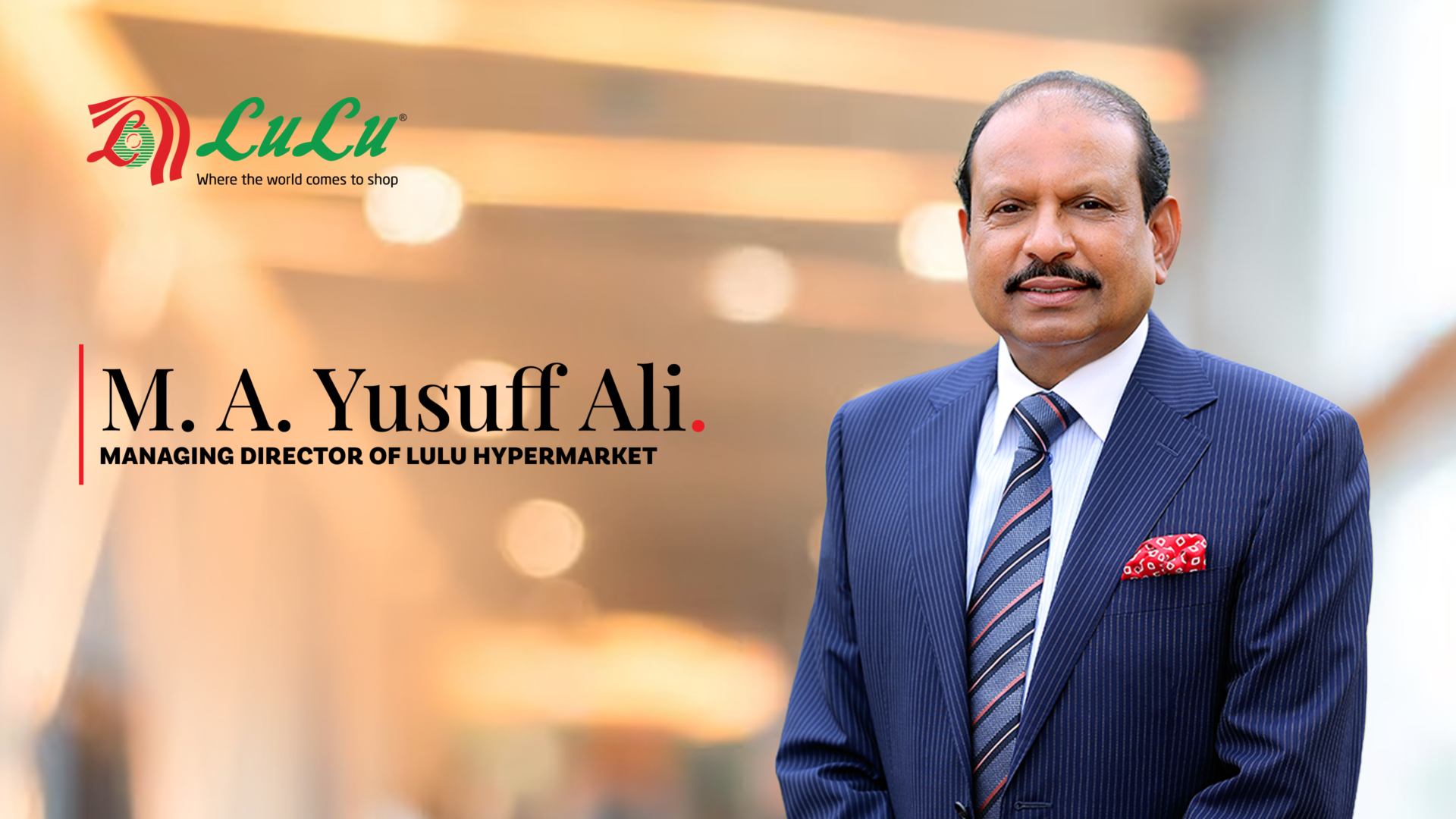
In the long and varied history of global commerce, the most enduring enterprises are rarely built by ambition alone. They are shaped by patience, discipline, and an almost quiet commitment to understanding people. The story of M. A. Yusuff Ali, founder and Chairman of LuLu Group International, reflects precisely this kind of entrepreneurial journey.
What began as the migration of a young man from a modest village in Kerala would gradually evolve into one of the most influential retail networks serving millions of families across continents. Today, LuLu Group operates hundreds of hypermarkets, supermarkets, and shopping malls across the Middle East, Asia, Europe, and Africa, employing tens of thousands of people and shaping the daily shopping habits of diverse communities.
Yet the deeper significance of this journey lies not simply in scale or valuation. It lies in the philosophy that guided the enterprise from its earliest days: the belief that commerce, when rooted in trust and cultural understanding, can become far more than a business. It can become an institution.
Early Life and Migration: A Village Beginning that Shaped a Global Vision
Yusuff Ali was born on 15 November 1955 in the coastal village of Nattika in Kerala’s Thrissur district, a region where small trading communities formed the backbone of local economic life.
His father ran a modest grocery shop, and it was within that environment that the young Yusuff Ali first absorbed the fundamental rhythms of commerce. Transactions were not anonymous exchanges but relationships built over years. Customers returned because they trusted the shopkeeper, and that trust was sustained through consistency, fairness, and reliability. These lessons, though simple, proved foundational.
In 1973, at the age of eighteen, he travelled to Abu Dhabi to join a small trading business run by his uncle, arriving in a Gulf region that was only beginning to experience the transformative effects of oil-driven economic growth.
Cities were expanding rapidly, construction projects were multiplying, and expatriate workers from across Asia and Africa were arriving in unprecedented numbers. Yet the retail landscape had not evolved at the same pace.
The Origin of an Idea: Recognising the Needs of Migrant Communities
During his early years in the trading business, Yusuff Ali worked across every layer of operations. He assisted with logistics, managed invoices, coordinated imports, and interacted directly with retailers and customers.
Those experiences gave him something more valuable than formal training: a clear understanding of how communities lived and shopped.
He observed that expatriate families in the Gulf often struggled to find familiar products from their home countries. Everyday groceries, spices, and staple foods were scattered across small stores with inconsistent pricing and limited selection.
Gradually, he realised that retail could do more than simply sell products. It could provide a sense of familiarity and belonging for people living far from home.
This insight would eventually shape the philosophy behind LuLu’s retail model.
The Defining Turning Point: Creating the LuLu Hypermarket Model
By the early 1990s, the Gulf’s economic landscape had matured sufficiently to support larger retail formats. Recognising the opportunity, Yusuff Ali made a decision that would transform his entrepreneurial trajectory.
In 1995 he established the first LuLu supermarket in Abu Dhabi, introducing a large-scale retail concept that combined international sourcing, transparent pricing, and extensive product variety within a single shopping environment.
The concept represented more than a commercial innovation. For expatriate families it created a space where familiar foods from India, Pakistan, Southeast Asia, and the Middle East could be found under one roof.
Shopping, in other words, became an experience of cultural continuity rather than displacement.
Within a few years, the success of the model led to expansion across the Gulf Cooperation Council countries, laying the foundation for what would become a global retail network.
Building a Global Retail Institution
Over the following decades, LuLu Group grew into one of the largest retail enterprises operating in the Middle East. Today the organisation runs more than 240 hypermarkets and shopping destinations while employing over 65,000 people from more than forty nationalities.
The expansion was not driven by store numbers alone. Yusuff Ali invested heavily in the infrastructure that sustains modern retail: global sourcing offices, advanced logistics systems, food processing facilities, and supply networks capable of maintaining consistent quality across multiple markets.
Such operational discipline ensured that customers could rely on availability, affordability, and variety, three elements that gradually built deep loyalty across communities.
The organisation also expanded into hospitality, food processing, and international trade, connecting farmers and manufacturers from Asia with global markets.
Trials, Leadership, and the Lessons of Growth
Every entrepreneurial journey encounters moments of uncertainty, and the growth of LuLu Group was no exception.
Economic fluctuations, regional instability, and the complexity of managing multinational supply chains tested the resilience of the organisation. These challenges reinforced an important lesson for Yusuff Ali: expansion without strong systems is fragile.
As the company matured, his leadership style evolved from direct operational involvement to institutional stewardship, emphasising the development of capable teams and long-term partnerships with employees, suppliers, and communities.
As he has often reflected, “Trust is the most valuable capital any business can possess. Money may build stores, but only trust builds institutions.”
Impact Beyond Commerce: Philanthropy and Social Responsibility
Beyond retail success, Yusuff Ali has also been recognised for his philanthropic contributions.
Through corporate social responsibility initiatives and personal donations, he has supported disaster relief efforts, educational programmes, and community welfare projects across several countries. His contributions have assisted victims of major crises, including the Gujarat earthquake, the Asian tsunami, and the Kerala floods.
His contributions to business and society have been recognised with honours such as India’s Padma Shri and the Pravasi Bharatiya Samman, awarded to overseas Indians who have made exceptional contributions globally.
Personal Values and the Human Side of Leadership
Despite his global prominence, Yusuff Ali remains closely connected to his roots in Kerala. Family, faith, and community continue to anchor his perspective.
The migrant experience that shaped his early life, the humility of starting from modest beginnings and the discipline required to succeed in unfamiliar environments, continues to influence the culture of LuLu Group today.
Indeed, the organisation has become one of the largest employers of the Indian diaspora worldwide, reflecting the diverse communities it serves.
Legacy and the Future of LuLu Group
Today, Yusuff Ali stands among the most influential business leaders of the global Indian diaspora, with a retail empire spanning continents and a personal fortune valued in billions. Yet his ambitions extend beyond wealth or expansion.
LuLu Group continues to invest in digital commerce, global sourcing networks, and next-generation retail infrastructure, ensuring that the organisation remains relevant in an evolving economic landscape.
If the journey of M. A. Yusuff Ali is remembered decades from now, it will not merely be as the story of a successful businessman. It will stand as a testament to the transformative power of migration, resilience, and institutional trust.
From a small grocery shop in coastal Kerala to a multinational retail network headquartered in Abu Dhabi, his life illustrates a profound truth about entrepreneurship: that the most enduring enterprises are built not only through vision, but through the steady practice of integrity.