

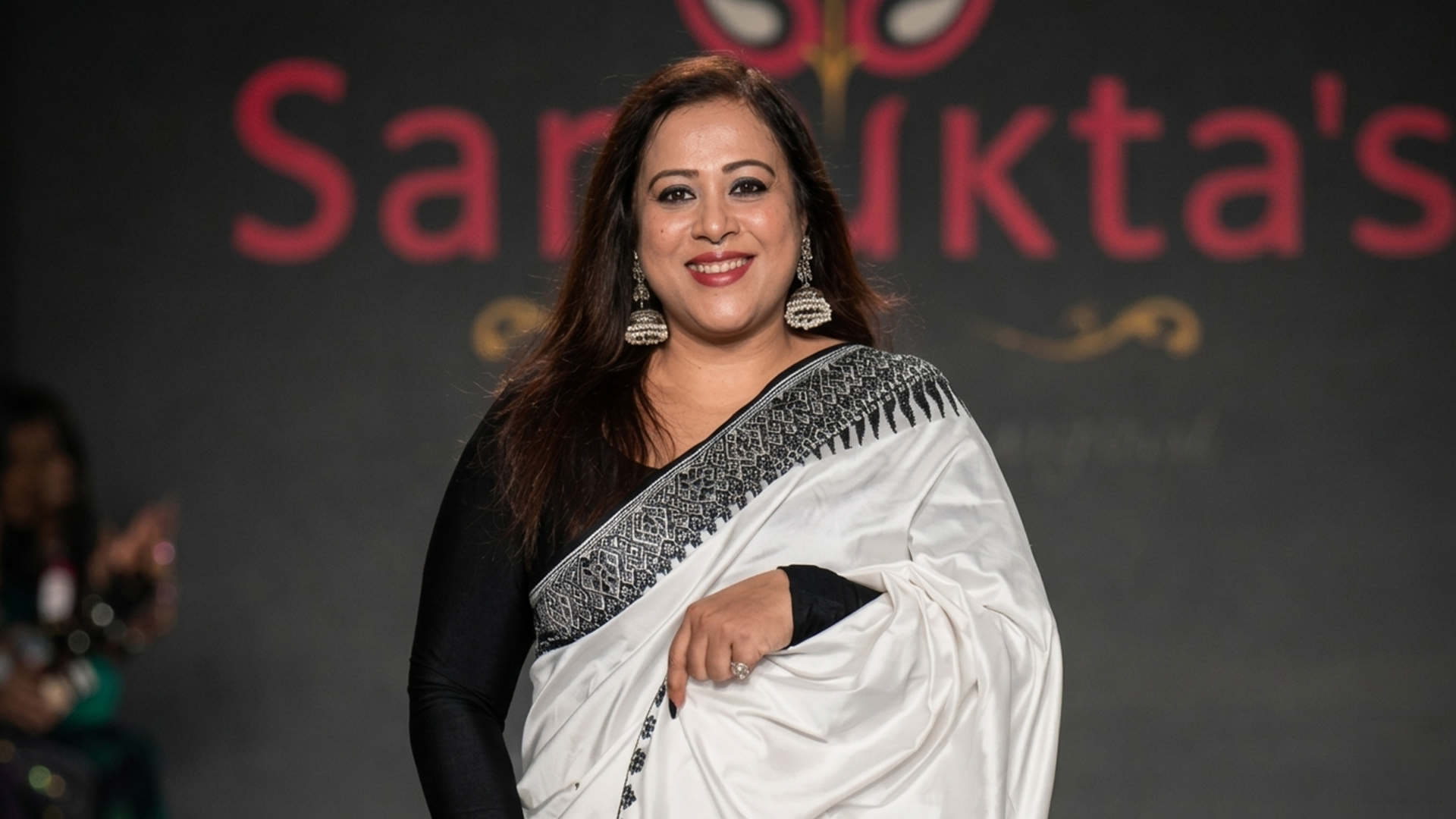
In the river valleys of Assam, the rhythmic sound of wooden looms has echoed for centuries, producing textiles that embody artistry and cultural memory. Among them, the golden threads of Muga silk, the elegance of Pat silk, and the warmth of Eri silk stand as enduring symbols of the region’s identity. Yet despite their remarkable heritage, these textiles remained largely confined to regional markets for decades, admired locally but rarely recognised on the international fashion stage.
It took the vision of a determined designer to bridge this divide between tradition and global visibility. Sanjukta Dutta, an Assamese fashion entrepreneur whose journey began not in a design studio but in engineering, has emerged as one of the most prominent ambassadors of the region’s handloom heritage. Through her work, she has transformed the traditional Mekhela Chador into a contemporary couture statement, introducing global audiences to a garment that carries centuries of craftsmanship within its folds.
Her story is not only one of creative reinvention but also a testament to how cultural pride, entrepreneurial courage, and design innovation can reshape the destiny of a regional craft.
Growing Up Amid Assam’s Textile Traditions
Sanjukta Dutta was born in the culturally vibrant district of Nagaon in Assam, where weaving forms an integral part of everyday life. In many Assamese households, the loom occupies a place of both utility and artistic expression, translating heritage into patterns and colour.
From childhood, Dutta observed the elegance of the Mekhela Chador, the traditional two-piece attire worn by Assamese women during festivals, ceremonies, and daily life. Woven in silk and decorated with motifs inspired by nature and folklore, the garment symbolises cultural continuity.
These early impressions nurtured her creative sensibility. Though fashion was not initially considered a career path, she often experimented with designing garments for friends and family. What began as a simple interest would later become the foundation of a transformative professional journey.
Engineering Discipline and a Decade in Public Service
Before entering fashion, Sanjukta Dutta built a career in engineering. She graduated from Assam Engineering College and later joined the Public Works Department (PWD) of Assam as an Assistant Engineer.
For nearly a decade, she worked within the structured environment of government service, contributing to infrastructure and development projects. Engineering demanded analytical thinking, planning, and resilience, skills that later proved invaluable when she began building her own enterprise.
Yet despite the stability of her profession, the fascination with fabrics, colours, and Assamese motifs never disappeared.
Gradually, that creative pull began shaping a different vision for her future.
A Bold Turning Point: From Technocrat to Designer
Leaving a secure government career is rarely easy. Nevertheless, in 2012, Sanjukta Dutta chose to step away from engineering to pursue her deeper calling, reviving Assamese textiles through contemporary fashion.
Her venture began modestly with three looms and an investment of approximately ₹15 lakh. From this small beginning emerged a design label dedicated to Assamese handloom traditions.
The response from customers was immediate. Within the first eighteen months, her studio sold nearly 3,000 Mekhela Chador sets, revealing strong demand for traditional garments presented with modern aesthetics.
Over time, the enterprise expanded steadily. Today her work supports more than a hundred looms and numerous weaving families across Assam.
Reflecting on her vision, Dutta has often said, “My dream has always been to see the Mekhela Chador recognised across the world as a symbol of Assamese identity.”
Redefining the Mekhela Chador for Contemporary Couture
One of the most distinctive aspects of Sanjukta Dutta’s work is her commitment to preserving authenticity while adapting traditional garments for modern audiences.
Rather than radically altering the Mekhela Chador, she reinterprets it through subtle design innovation. Traditional motifs inspired by flora, fauna, and Assamese cultural symbols remain central to her creations, while silhouettes and draping techniques are refined for contemporary styling.
Her collections prominently feature Assam’s three iconic silks:
●Muga silk, known for its natural golden sheen and durability.
●Pat silk, valued for its smooth texture and luminous elegance.
●Eri silk, celebrated for its warmth and eco-friendly production.
By presenting these textiles through modern design, Dutta has repositioned Assamese handloom within the global fashion conversation.
Empowering Artisans and Reviving Handloom Livelihoods
Beyond aesthetics, Sanjukta Dutta’s work carries important socio-economic implications. Assam’s handloom industry has long faced challenges including declining demand and competition from machine-produced fabrics.
Recognising these vulnerabilities, she built her design ecosystem around collaboration with traditional weavers. By providing consistent orders and fair compensation, her label has helped sustain livelihoods within artisan communities.
As Dutta has observed in interviews, “Every garment we create carries the labour and skill of many hands. Supporting our weavers is not separate from design, it is part of the process itself.”
Taking Assamese Silk to Global Fashion Capitals
A defining moment in Sanjukta Dutta’s career arrived when her collections began appearing on international fashion platforms. Her designs have since been showcased at major events including New York Fashion Week, Paris Fashion Week, and Milan Fashion Week.
These runway presentations introduced international audiences to the elegance of Assamese textiles. The Mekhela Chador, once unfamiliar outside Northeast India, began attracting admiration from fashion enthusiasts and designers around the world. Through these appearances, Dutta successfully positioned Assamese silk within the landscape of global luxury fashion.
Fashion as Cultural Storytelling
Another defining characteristic of Sanjukta Dutta’s work is its narrative depth. Her collections often draw inspiration from Assamese music, folklore, landscapes, and cultural icons.
In one collection, she paid tribute to celebrated Assamese musician Zubeen Garg, weaving symbolic motifs into the garments themselves. Such creative gestures demonstrate how fashion can function as a medium of cultural storytelling.
Through carefully chosen colours, patterns, and textures, Dutta transforms garments into visual narratives that reflect the cultural landscape from which they emerge.
A Legacy Woven in Silk
Sanjukta Dutta’s journey from engineer to internationally recognised designer reflects the transformative power of conviction and cultural pride. By stepping away from a secure career, she chose instead to champion a heritage that might otherwise have remained confined to regional appreciation.
Today, her work stands as an example of how traditional craftsmanship can thrive within the modern fashion ecosystem. Through innovation grounded in respect for heritage, she has elevated Assamese textiles to global recognition.
With every thread of silk that passes through the looms she supports, the story of Assam continues to travel across the world, elegant, resilient, and timeless.
