

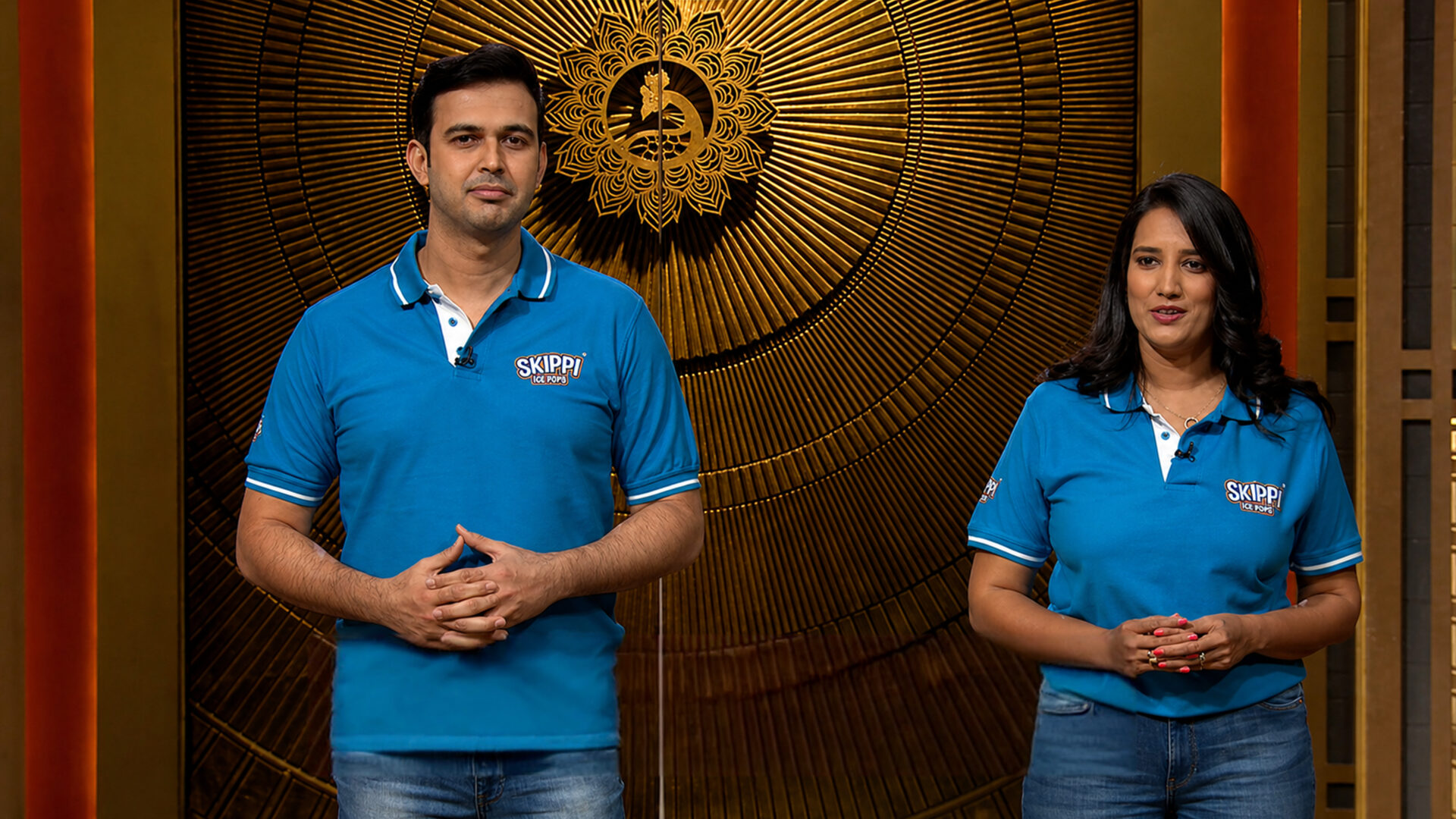
In India, summer has always carried with it a quiet, almost universal ritual, the fleeting joy of a ₹5 ice pop, purchased from a street vendor, its bright colours melting faster than time itself. For many, it was a memory wrapped in sweetness and spontaneity; for some, it was also accompanied by a quiet hesitation, an unspoken concern about hygiene, ingredients, and safety. It is within this delicate tension between joy and doubt that the journey of Ravi Kabra and Anuja Kabra truly begins, not as entrepreneurs chasing disruption, but as observers unwilling to ignore a contradiction that had long been normalised.
Early Observations and the Seed of an Idea
Ravi Kabra’s exposure to international markets, particularly during his time in Australia, had quietly shaped his understanding of consumer behaviour. He had witnessed how even the most ordinary products were subject to rigorous standards of safety and consistency. Returning to India, the contrast was immediate and, in certain moments, unsettling. While the country was rapidly modernising across sectors, everyday consumables at the grassroots level often remained untouched by this transformation.
Ice pops stood out not because they were extraordinary, but because they were so deeply ordinary. They were everywhere, outside schools, in neighbourhood lanes, in small-town marketplaces, yet they existed almost entirely outside the framework of trust. The more Ravi reflected on this, the more it ceased to feel like a trivial observation and began to resemble a meaningful gap.
For Anuja Kabra, whose inclination towards product development and quality control complemented Ravi’s strategic thinking, the idea carried both emotional and practical weight. This was not merely about identifying an opportunity; it was about addressing something that felt incomplete. The question was no longer whether the category could be improved, but whether they were willing to take the risk of doing so.
The Decision to Build: Simplicity as a Risk
What makes the Skippi story particularly compelling is that its core idea was, on the surface, almost disarmingly simple. There was no technological breakthrough, no radical invention, only a familiar product waiting to be reimagined. Yet, therein lay the challenge. Simplicity, in the world of entrepreneurship, is often met with scepticism. Could something so inexpensive, so commonplace, truly become a scalable business?
For the Kabras, this uncertainty was real. The idea did not immediately present itself as a conventional startup success story. It required conviction, the belief that a product dismissed as trivial could, in fact, hold immense untapped potential. Choosing to pursue it meant stepping into a space where validation was scarce and doubt was inevitable. And yet, they moved forward.
Building Skippi: From Concept to Credibility
The early stages of building Skippi Ice Pops were defined by a singular focus: trust. If the product was to be accepted within a structured market, it needed to address the very concerns that had historically surrounded it. This meant rethinking not just the formulation, but the entire experience.
Working meticulously on ingredients, the Kabras ensured that Skippi’s ice pops were free from artificial preservatives and aligned with safer consumption standards. Equally important was the process, controlled manufacturing environments replaced informal production methods, introducing consistency where there had once been unpredictability.
Branding, too, became a crucial element. Where traditional ice pops were anonymous, Skippi was designed to be instantly recognisable, vibrant, approachable, and aligned with modern retail sensibilities. It was a deliberate shift from invisibility to identity.
These decisions, while straightforward in hindsight, required persistence in execution. Building credibility in a category that had never demanded it was, in itself, a challenge.
The Shark Tank India Moment: Validation and Visibility
The turning point in the founders’ journey came with their appearance on Shark Tank India. For Ravi and Anuja, this was not merely a pitch, it was a moment of validation for an idea that had, until then, existed on the margins of mainstream attention.
There was, inevitably, a question that lingered beneath the surface: would investors recognise the potential in something so fundamentally simple?
What followed would become one of the most defining moments of their journey. Skippi secured an “all-shark deal”, with every investor choosing to back the company, a rare outcome that signalled not just belief in the product, but in the founders themselves.
The impact was immediate. Monthly revenues surged from approximately ₹5 lakh to nearly ₹2 crore, and the brand rapidly expanded its footprint across India. Yet, beyond the numbers, the moment represented something more profound, a transition from uncertainty to affirmation.
Scaling the Vision: Opportunity Meets Complexity
With visibility came scale, and with scale came complexity. As Skippi expanded into thousands of retail outlets and established a presence across digital platforms, the nature of the founders’ challenges began to evolve. What had once been a question of validation now became a question of sustainability.
Managing inventory, maintaining product consistency across growing volumes, and ensuring that demand remained aligned with supply introduced a new layer of responsibility. Reports of revenue fluctuations in subsequent phases highlighted the pressures that accompany rapid growth.
For Ravi and Anuja, this phase was not a departure from their journey, but an extension of it. It required a shift from instinct to structure, from momentum to measured execution. The simplicity that had once made the idea powerful now demanded disciplined management to sustain it.
A Partnership Defined by Complementary Strengths
At the heart of Skippi’s evolution lies the partnership between its founders. Ravi’s ability to identify opportunity and think in terms of scale found balance in Anuja’s attention to product integrity and operational detail. This alignment allowed the company to navigate both expansion and uncertainty with a degree of cohesion that is often absent in early-stage ventures.
Their journey underscores an important entrepreneurial truth: that enduring businesses are rarely built on individual brilliance alone, but on the strength of complementary perspectives working towards a shared vision.
Redefining Value Through Perspective
What Skippi ultimately represents is a shift in perception. By recognising the latent potential within a ₹5 product, the Kabras demonstrated that innovation need not always be complex or revolutionary. Sometimes, it lies in the ability to see what others overlook and to take it seriously enough to build upon it. They did not create a new desire; they refined an existing one. They did not disrupt behaviour; they elevated it.
The Courage to See the Ordinary Differently
As Skippi Ice Pops continues to evolve within India’s competitive FMCG landscape, its story remains, at its core, a founder’s journey, one shaped not by dramatic invention, but by quiet conviction. Ravi and Anuja Kabra did not set out to build something extraordinary; they set out to make something ordinary better.
In doing so, they transformed a fleeting childhood indulgence into a scalable business, and a moment of nostalgia into a meaningful enterprise. Their journey serves as a reminder that in a country as vast and layered as India, opportunity often resides in the most familiar places, waiting not for reinvention, but for recognition. And sometimes, all it takes is the courage to look at a ₹5 memory and see, within it, the blueprint of something far greater.
